
MDMA Therapy in Australia: A 2026 Guide
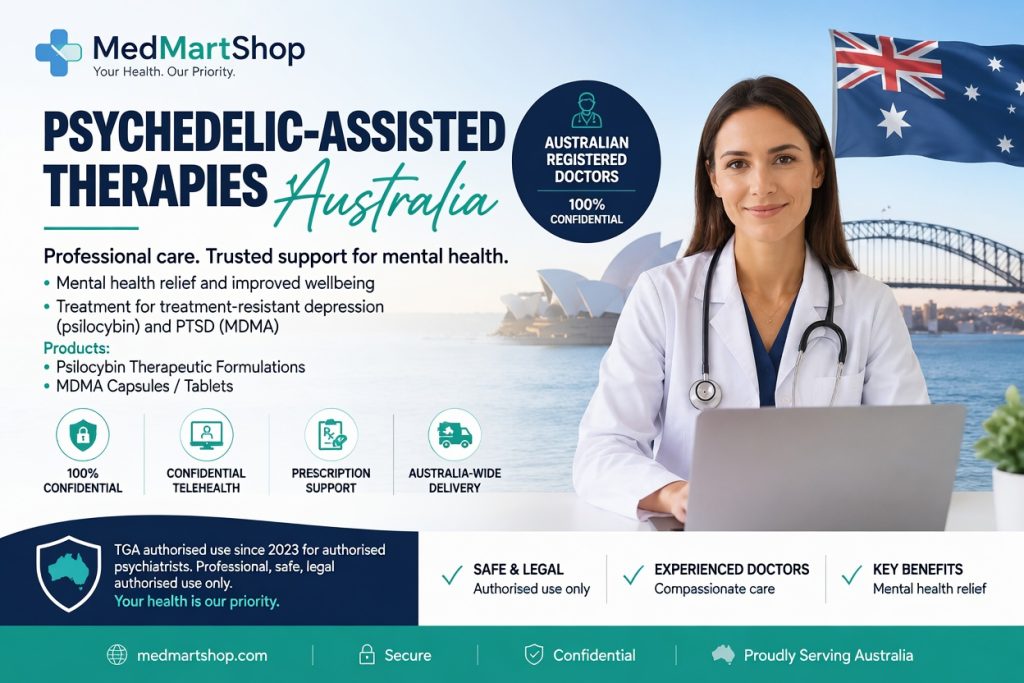
Australia has made history by becoming the first country to formally recognise MDMA as a prescription medicine for approved psychiatric conditions . Since July 2023, authorised psychiatrists have been able to prescribe MDMA for post-traumatic stress disorder (PTSD), marking a revolutionary shift in mental health treatment . Consequently, a new therapeutic model has emerged that combines the drug’s unique effects with structured psychotherapy. This guide explores the current state of MDMA-assisted therapy in Australia, including the recent regulatory changes, treatment protocols, costs, and the challenges that remain.
How MDMA-Assisted Therapy Works
MDMA-assisted psychotherapy is not a daily medication. It comprises a structured intervention with preparation, dosing, and integration phases . Dosing sessions can take up to eight hours and involve therapeutic input from psychiatrists and psychologists.
In MDMA-assisted therapy, the drug’s effects are harnessed for specific therapeutic purposes. The drug floods the brain with serotonin, dopamine, oxytocin, and other neurotransmitters that play fundamental roles in regulating euphoria, movement, and memory. It also reduces activity in the amygdala, frequently referred to as the “fear centre” of the brain. This allows patients to confront deeply buried trauma that is often the unrecognised root of their depression or distress.
The treatments typically involve three dosing sessions, each separated by at least a month, with psychotherapy before and after each session . Therefore, the therapeutic process is intensive and time-consuming, reflecting the complexity of the conditions being treated.
The Regulatory Framework: 2023 to 2026
When the TGA first rescheduled MDMA from a Schedule 9 (Prohibited Substance) to Schedule 8 (Controlled Drug) medicine in July 2023, it paved the way for authorised psychiatrists to administer the treatment outside of clinical trials . However, procedural and practical challenges emerged during the early implementation .
Consequently, the TGA undertook a review of the Authorised Prescriber scheme. This involved consulting with over 80 stakeholders, including authorised prescribers, human research ethics committees (HRECs), and professional bodies . The result was a set of four key recommendations released in mid-2026.
The Four Key Recommendations
Recommendation 1: Psychiatrist Experience
Psychiatrists wanting to obtain Authorised Prescriber status must now show they have experience in psychedelic-assisted psychotherapy . They can do this by either participating in relevant clinical trials or being supervised by an experienced authorised prescriber. This dual pathway was introduced because relatively few psychiatrists have clinical trial experience. Restricting access to that group alone would have significantly limited patient access .
Recommendation 2: Therapy Team Composition
The therapy dyad must now include at least one therapist registered with a specified National Board . Eligible professions include clinical psychologists, medical practitioners with general registration, nurses with mental health experience, and occupational therapists .
Importantly, the second practitioner in the dosing room may be drawn from a wider pool of suitably trained professionals . This includes psychotherapists, counsellors, social workers, and Aboriginal and Torres Strait Islander health workers . The authorised prescriber psychiatrist takes responsibility for determining qualifications and competency of any additional practitioners .
This change is designed to support workforce capacity in rural and regional areas, address shortages, and improve culturally appropriate care .
Recommendation 3: Prescriber Oversight
The authorised prescriber psychiatrist must now personally conduct patient screening and ongoing informed consent . They must be physically present on-site during medicine administration to manage any immediate issues or adverse events .
Notably, the psychiatrist does not need to remain for the full eight-hour dosing day . This preserves flexibility to support service accessibility while maintaining safety standards.
Recommendation 4: Treatment Site Standards
The TGA has now set clear minimum standards for treatment sites . Treatment can be delivered in any medically supervised environment that meets defined safety requirements. These include:
- Secure Schedule 8 medicine storage
- Trained staff and equipment for clinical care and resuscitation
- Access to rescue medications
- Proximity to an accredited healthcare facility with an emergency department within 15 minutes
Crucially, treatment is no longer restricted to hospital settings . This represents a significant shift from earlier assumptions that day hospital or inpatient settings were required. Less clinical, more therapeutic environments may improve patient comfort and outcomes .
Clinical Guidelines and Patient Eligibility
The world-first clinical practice guide on MDMA-assisted psychotherapy was published in February 2026 . Compiled by Monash University, the guideline is aimed at GPs and other health professionals involved in managing patients with PTSD.
The authors do not recommend the treatment as part of routine care . It should be limited to patients over 18 who have been diagnosed with PTSD and have had symptoms for at least six months, including moderate to severe symptoms in the past month . Patients should also have had an adequate trial of first-line evidence-based treatments and not be likely to be re-exposed to significant trauma during treatment.
The guideline “strongly recommends” against use among patients who have been excluded from clinical trials for safety reasons . These include those who are pregnant or breastfeeding, with cardiovascular disease, psychotic disorder, or suicide-related distress, as well as those using medications which may interact with MDMA.
The Results: Promising Early Data
Over the past two years, the early results have been striking. More than half of patients who received MDMA along with psychotherapy reported significant relief from PTSD . Australian drug regulators have not recorded any serious adverse events among the nearly 200 patients who have been through the program since December 2025 .
Dr Ranil Gunewardene, a psychiatrist in Sydney who has treated more than 40 patients, described the outcomes as “extraordinary” compared to conventional treatments . Patient testimonials echo this sentiment. Duncan Livingston, who suffered from PTSD and depression for over four decades, described the treatment as allowing him to be “reborn” .
However, the evidence base has limitations. Only around 330 people have been through clinical trials globally, and we don’t yet have long-term evidence. Studies typically stop at the end of treatment .
The Cost and Access Challenge
Despite regulatory approval, access remains severely limited. With an average cost of $20,000 for up to three dosing sessions and 40 hours of counselling, MDMA therapy is largely out of reach for the estimated one million Australians who suffer from PTSD .
Other rules contribute to the program’s high costs. The prescribing psychiatrist must remain on site during the six-to-eight hour dosing sessions along with two psychologists who sit with the patient . The licensing process, which includes approval by an ethics panel, can take six months .
Fewer than 50 psychiatrists are authorised to prescribe the drugs in a country of 28 million people, and most practice in a handful of coastal cities . The government prohibits drug advertising, so many patients are unaware the therapies exist .
Tania de Jong, the executive director of Mind Medicine Australia, said a growing backlog had swelled the organisation’s waiting list to more than 1,000 people . “Given the immense suffering of patients who potentially could end up taking their own lives, the lack of access is unacceptable,” she stated.
Progress on Reimbursement
On a positive note, reimbursement for psychedelic-assisted therapy now spans both public and private funding systems . Public coverage includes the Department of Veterans’ Affairs (DVA), the National Disability Insurance Scheme (NDIS), and WorkCover schemes . Private coverage includes Medibank, Australia’s largest private health insurer .
Dr Andrew Wilson, Medibank’s chief medical officer, noted that the company hoped the therapy would lead to a reduction in mental-health-related hospitalisations, which cost the company $1.4 billion each year . Half of all psychiatric patients covered by the company are readmitted within 12 months, indicating the current system’s limitations.
The Safety Debate
The regulatory changes have sparked debate among clinicians. Clinical psychologist Shai Hipperson expressed serious reservations . She noted that there is currently no standardised benchmark for training, leaving patients uncertain whether their therapists have completed a two-day or a two-year training course .
The Australian Association of Psychologists has also strongly criticised the changes . They stated that the new framework would prevent approximately 70 percent of psychologists from providing psychedelic-assisted therapy .
Nevertheless, the TGA maintains that stringent oversight is necessary given that MDMA is considered an experimental and unapproved medication . The clean safety profile accumulated under regulated commercial conditions supports the case for continued program expansion .
Conclusion
MDMA therapy in Australia represents a remarkable transformation in mental health treatment. Australia has demonstrated global leadership by becoming the first country to regulate MDMA as a prescription medicine . Consequently, the early results have been impressive, with significant patient relief and a clean safety record.
However, the path forward requires addressing significant barriers. The cost of treatment puts it out of reach for most Australians. The limited workforce restricts access, and ongoing safety debates highlight the need for clear training standards. Therefore, as Australia continues to refine this innovative therapy, the challenge will be to balance safety with accessibility. The decisions made today will determine whether this remarkable treatment fulfils its potential as a tool for healing, or remains accessible only to the fortunate few.