
5-MeO-DMT Therapy in Australia: Clinical Trials, Access, and the Future of Treatment
The question of whether 5-MeO-DMT therapy is available in Australia has become increasingly relevant. Global research into psychedelic-assisted treatments continues to accelerate. This potent compound, often called “the God molecule,” is being investigated for its remarkable potential. Researchers are testing it for treating severe mental health conditions. Consequently, understanding the current therapeutic landscape in Australia requires examining clinical research, legal frameworks, and the practical realities of access. This guide provides a comprehensive, Australia-oriented overview of 5-MeO-DMT therapy.
Understanding 5-MeO-DMT as a Therapeutic Agent
First and foremost, you must understand what distinguishes 5-MeO-DMT from other psychedelics in a therapeutic context. 5-MeO-DMT is an atypical psychedelic. It differs from most serotonergic psychedelics in having much greater activity at the serotonin 5-HT1A receptor. It also acts on the 5-HT2A receptor . This unique receptor profile contributes to its distinctive effects. These effects are primarily non-visual and profoundly psychological.
The compound acts as a non-selective serotonin receptor agonist . Researchers have described it as producing subjective effects notably distinct from those of DMT. These include a relative lack of visual effects . The drug reliably produces mystical experiences in most people who take it. This may contribute to its therapeutic potential .
Australian Clinical Research: The Monash University Program
Australian clinical research into 5-MeO-DMT therapy is underway. The Clinical Psychedelic Lab at Monash University is Australia’s first psychedelic lab. It is pioneering a rigorous program of research and training in psychedelic therapies . The lab is focused on investigating novel applications for psychedelic therapies. It also translates evidence into best clinical practice, explores and mitigates under-examined risks, delivers next-generation therapist training, and improves access and affordability .
The lab, led by Dr Paul Liknaitzky, has conducted clinical trials using psilocybin, MDMA, and 5-MeO-DMT. These trials address depression, anxiety, post-traumatic stress, and other mental health conditions . Dr Joe Starke, a clinician at The Peridot Clinic, has been part of the Clinical Psychedelic Lab since 2023. He contributes to an international multi-site trial of 5-MeO-DMT for treatment-resistant depression .
However, recruitment for the 5MeO-DMT-assisted therapy for Treatment-Resistant Depression trial is now closed as of September 2025 . This highlights the competitive and constrained nature of these research opportunities. The Australia Psychedelic Report 2026 confirms that Australian clinical and institutional activity has broadened. It now covers psilocybin, ketamine, DMT-harmala, and 5-MeO-DMT work .
International Clinical Evidence: The BPL-003 Trials
The most significant clinical evidence for 5-MeO-DMT therapy comes from international trials of BPL-003. This is an intranasal formulation of mebufotenin (5-MeO-DMT) benzoate. A Phase 2b study including 193 participants demonstrated rapid, durable, and statistically significant reductions in depressive symptoms. Participants had treatment-resistant depression .
The study used a randomized, quadruple-masked, 8-week design. At day 29, participants receiving 12 mg of BPL-003 showed a mean 11.1-point reduction from baseline. This was measured on the Montgomery-Åsberg Depression Rating Scale (MADRS). The control group receiving 0.3 mg showed a reduction of 5.8 points (P = .004) . The 8 mg dose produced an even more pronounced MADRS reduction of 12.1 points (P = .003) .
The antidepressant effects emerged rapidly. Both the 8 mg and 12 mg doses showed statistically significant improvements as early as day 2 post-dosing . Durability of the antidepressant response was notable. Effects were maintained through the 8-week follow-up period . There were no drug-related serious adverse events. More than 99% of treatment-emergent adverse events were mild or moderate .
The clinical practicality of BPL-003 administration aligns with existing interventional psychiatry treatment paradigms. The majority of participants met readiness for discharge criteria at the 90-minute post-dose assessment. Average discharge readiness occurred within 2 hours across all treatment arms . This short in-clinic time could potentially facilitate integration into current treatment workflows. These workflows are established by esketamine (Spravato) .
Phase 2a Evidence: Intranasal 5-MeO-DMT with SSRIs
Additional evidence comes from a Phase 2a open-label clinical trial. This trial evaluated intranasal 5-MeO-DMT administered adjunctively to stable selective serotonin reuptake inhibitor (SSRI) treatment. Participants were adults with treatment-resistant depression . Twelve participants with moderate-to-severe major depressive disorder received a single dose of 10 mg or 12 mg 5-MeO-DMT alongside SSRIs.
The trial showed rapid and sustained reductions in depressive symptoms. These were measured by the MADRS over 12 weeks . The treatment was generally well tolerated. Adverse events were mild and transient. They included administration-site irritation and transient blood pressure elevations. No serious adverse events or suicidality were reported during the trial . Limitations include the small sample size, lack of a control group, and limited ethnic diversity. These indicate the need for larger controlled studies to confirm these findings .
The Australian Legal Framework for Psychedelic Therapy
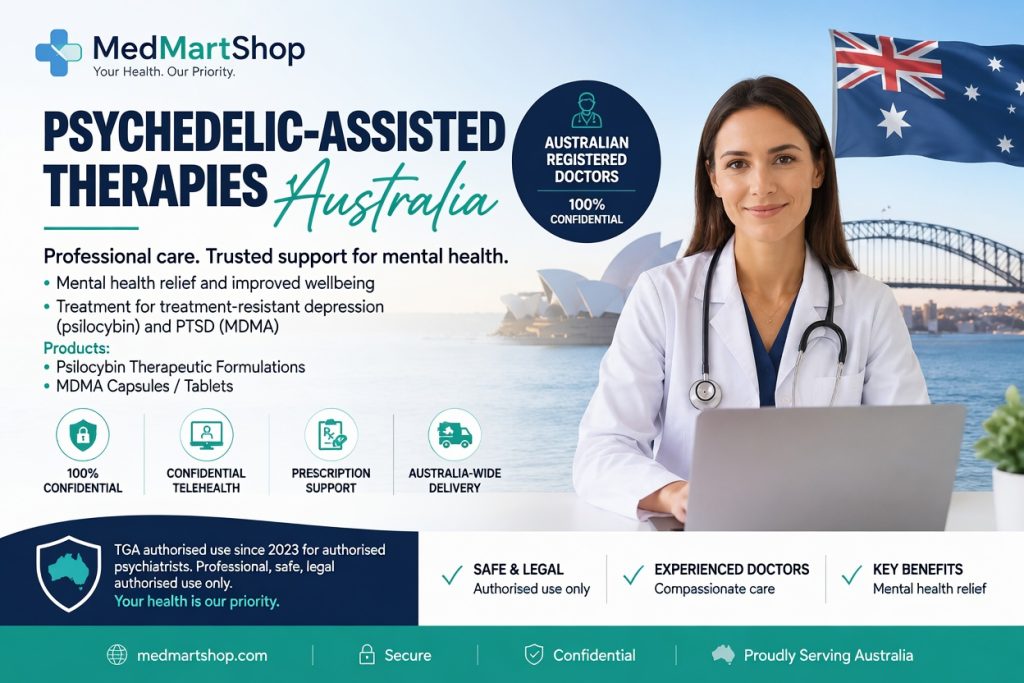
Understanding the legal context is essential. Australia made history on 1 July 2023. It became the first country to allow authorized psychiatrists to prescribe MDMA and psilocybin for specific mental health conditions . MDMA is approved for treatment-resistant post-traumatic stress disorder (PTSD). Psilocybin is approved for treatment-resistant depression (TRD) .
The Therapeutic Goods Administration (TGA) approved the use of these substances in clinical practice. This followed an exhaustive evaluation process lasting nearly three years . Under this clinical authorization, access is strictly regulated. It is only prescribed in cases resistant to other treatments. Psychiatrists must use the TGA’s Authorised Prescriber Scheme. They must also seek approval from a Human Research Ethics Committee (HREC) .
5-MeO-DMT is not included in this authorized therapeutic framework. Consequently, the only legal pathway to 5-MeO-DMT therapy currently exists through participation in approved clinical trials. The compound remains a Schedule 9 prohibited substance under the Poisons Standard in Australia .
The Underground Therapy Landscape
Since legal, clinical access remains scarce, some Australians turn to alternative channels. Underground psychedelic therapy has operated, largely with impunity, across Australia for the past 25 years . This network of facilitators has provided what many consider “lifesaving treatments.” They serve those seeking authentic healing .
A book titled “Psychedelic Chalice: Tales from the Aussie Underground” documents the wisdom of ten underground facilitators. They have worked with various compounds, including 5-MeO-DMT . Between them, they have clocked up thousands of hours of immersive practice. They offer treatments to those lucky enough to find them . They represent the true voices of wisdom and experience on psychedelic healing. Their gems of knowledge seem essential to informing the way forward. This applies to both legal mainstream psychedelic therapy and traumatised people looking for authentic healing .
However, this path carries significant legal and safety risks. The lack of regulation means that quality and safety cannot be guaranteed.
Preparation and Integration: Essential Components
Whether you access 5-MeO-DMT through clinical trials or underground channels, the work does not begin and end with the experience itself. Preparation and integration are two of “the most crucial stages for psychedelic healing to truly land in the body, mind, and spirit” .
Preparation involves the work you do before a journey—mentally, emotionally, physically, and spiritually. It helps you clarify your intention, set expectations, and create safety within yourself . This includes structuring “set and setting.” These are the foundation of a safe journey and the most powerful tools available to guide the experience .
Integration is everything that happens after—making meaning from your experience, processing emotions or insights, and weaving those learnings into your daily life . It is during integration that we create REAL and lasting change. This includes new neural pathways, new thoughts, new habits, and new behaviours . Without integration, a profound journey can fade like a dream. With it, transformation becomes sustainable .
Australian practitioners now offer specialized preparation and integration sessions. Clinical nutritionists, psychotherapists, and trained breathwork practitioners often provide these services . They offer non-judgemental, deeply supportive guidance. This helps navigate the full arc of the experience .
Cost and Accessibility Considerations
While 5-MeO-DMT therapy remains confined to clinical trials, understanding the cost landscape for legal psychedelic therapy provides important context. Since rescheduling on 1 July 2023, psilocybin-assisted therapy has become legally accessible only through private clinics. The estimated cost is approximately $25,000 per treatment . As it is not listed on the Pharmaceutical Benefits Scheme (PBS), access is effectively limited to wealthy Australians .
For those seeking 5-MeO-DMT therapy overseas, costs vary. The Inner Realms Center offers focused 5-MeO-DMT pathways starting at $2,400 USD. This is for a two-day private program under continuous clinical supervision . A four-day residential pathway costs $3,750 USD . These costs do not include travel, accommodation, or follow-up integration support.
Conclusion
5-MeO-DMT therapy in Australia remains an investigational treatment accessible only through clinical trials. The Monash University Clinical Psychedelic Lab has conducted research, but recruitment is currently closed . International trials of BPL-003 have shown remarkable promise. Rapid and durable antidepressant effects emerged as early as day 2 post-dosing and lasted through 8 weeks .
Australia’s legal psychedelic therapy framework currently covers only psilocybin and MDMA. This leaves 5-MeO-DMT as a Schedule 9 prohibited substance . The underground therapy network continues to operate, but carries significant risks .
For Australians interested in 5-MeO-DMT therapy, the responsible path involves supporting clinical research. It also involves advocating for evidence-based policy reform and awaiting the outcomes of ongoing trials. Preparation and integration support remain essential regardless of the access pathway . The future of 5-MeO-DMT therapy in Australia depends on continued research, regulatory evolution, and a commitment to safety and accessibility for all Australians.