
4-HO-5-MeO-DMT in Australia: The Unknown Compound
The compound 4-HO-5-MeO-DMT remains one of the most obscure and poorly understood psychedelic tryptamines in existence. This rare molecule, also known as psilomethoxin, combines structural features of both psilocin and 5-MeO-DMT. Consequently, understanding its status in Australia requires examining the very limited scientific literature, the legal framework governing analogues, and the significant safety concerns that researchers have raised. This guide provides a comprehensive, Australia-oriented overview of this enigmatic compound.
Understanding 4-HO-5-MeO-DMT: The Basics
First and foremost, you must understand what 4-HO-5-MeO-DMT actually is. This compound belongs to the tryptamine family of psychedelics. Its chemical structure combines features of two well-known compounds: psilocin (4-HO-DMT) and 5-MeO-DMT. Researchers sometimes refer to it as psilomethoxin or 5-methoxypsilocin.
Very little is known about this compound. The only report of it in the chemical literature dates back to a paper published by Marc Julia’s group at the Pasteur Institute in 1965. That paper reported a 10-step synthesis from ortho-vanillin and described the compound’s physical properties. However, no one has documented or explored the compound’s effects in any systematic way since that time.
Alexander Shulgin speculated that 4-HO-5-MeO-DMT could be biosynthesized by feeding 5-MeO-DMT to Psilocybe mushroom cultures. This hypothesis drew on a 1988 study by Jochen Gartz, who reported transforming DET into 4-HO-DET using a similar method. Shulgin described the compound as “a fascinating and promising compound to evaluate”. However, that evaluation has never occurred in any rigorous scientific setting.
The Safety Concern: A Potentially Dangerous Molecule
Despite the lack of research, scientists have raised serious concerns about 4-HO-5-MeO-DMT’s safety profile. These concerns centre on its structural similarity to known neurotoxins.
Researchers have noted that 4-HO-5-MeO-DMT bears a close structural resemblance to 4,5-dihydroxytryptamine (4,5-DHT) and 4-hydroxy-5-methoxytryptamine (4-HO-5-MeO-T). These compounds are known serotonergic neurotoxins. A 1973 study found that 4,5-DHT and 4-hydroxy-5-methoxytryptamine produced long-lasting depletion of brain serotonin and noradrenaline when administered to rats.
One researcher warned that 4-HO-5-MeO-DMT could be “the perfect candidate for a metabolic path capable of wiping out every serotonergic neuron in the brain.” The warning drew parallels to chemically-induced parkinsonism caused by MPTP and hydroxydopamine. The researcher emphasised that “we are not talking about a transient inconvenience: it is irreversible brain damage that is at stake”.
This concern led anonymous watchdogs to notify the DEA about the compound before any chemical content analyses were published.
The Church of Sacred Synthesis Controversy
The most prominent claims about 4-HO-5-MeO-DMT come from an organisation called the Church of Sacred Synthesis, formerly known as the Church of Psilomethoxin. Founded in 2022, this church claimed to produce psilomethoxin by feeding 5-MeO-DMT to psilocybin mushrooms.
The church sold its sacrament to members who joined online. Members received the sacrament through the mail, leading to the nickname “mail-order mushroom church”. The church claimed that the mushrooms biosynthesized psilomethoxin in addition to psilocybin.
However, independent testing undermined these claims. In 2023, chemists from the Usona Institute tested samples of the church’s sacrament. They found no traces of psilomethoxin or its putative prodrug 5-methoxypsilocybin. Instead, they found the usual constituents of psilocybin mushrooms: psilocybin, baeocystin, and psilocin.
Psychedelic researcher David E. Nichols stated that the church’s claims about psilomethoxin were “nonsensical and nonscientific”. When interviewed by Psymposia, church co-founder Greg Lake admitted that the church’s claims to a novel drug were based solely on “faith”.
The Australian Legal Status
Understanding the legal status of 4-HO-5-MeO-DMT in Australia requires examining the framework governing tryptamine analogues.
5-MeO-DMT is a Schedule 9 prohibited substance under the Australian Poisons Standard. The Customs (Prohibited Imports) Regulations explicitly list 5-methoxy-N,N-dimethyltryptamine (otherwise known as 5-MeO-DMT) as a prohibited import. This means its unlicensed possession, supply, importation, or manufacture is illegal.
DMT is also a Schedule 9 prohibited substance. The Australian Poisons Standard lists dimethyltryptamine as a Schedule 9 substance, making it illegal to sell, import, produce, and possess.
For 4-HO-5-MeO-DMT specifically, the situation is less clear because the compound has never been explicitly scheduled. However, Australia maintains strict drug analogue laws. The Australian Poisons Standard and customs regulations often extend control to compounds that are structurally similar to scheduled substances. One source notes that in countries with stricter drug analogue laws such as the USA or Australia, novel tryptamines produced through biosynthesis would also be illegal.
Given that 4-HO-5-MeO-DMT is structurally related to both psilocin (a Schedule 9 substance) and 5-MeO-DMT (a Schedule 9 substance), it would almost certainly fall under the same prohibitions in Australia. Consequently, possession, supply, or manufacture would carry severe legal penalties.
The Broader Australian Psychedelic Landscape
While 4-HO-5-MeO-DMT remains entirely outside legal channels, Australia has made significant progress in other areas of psychedelic medicine.
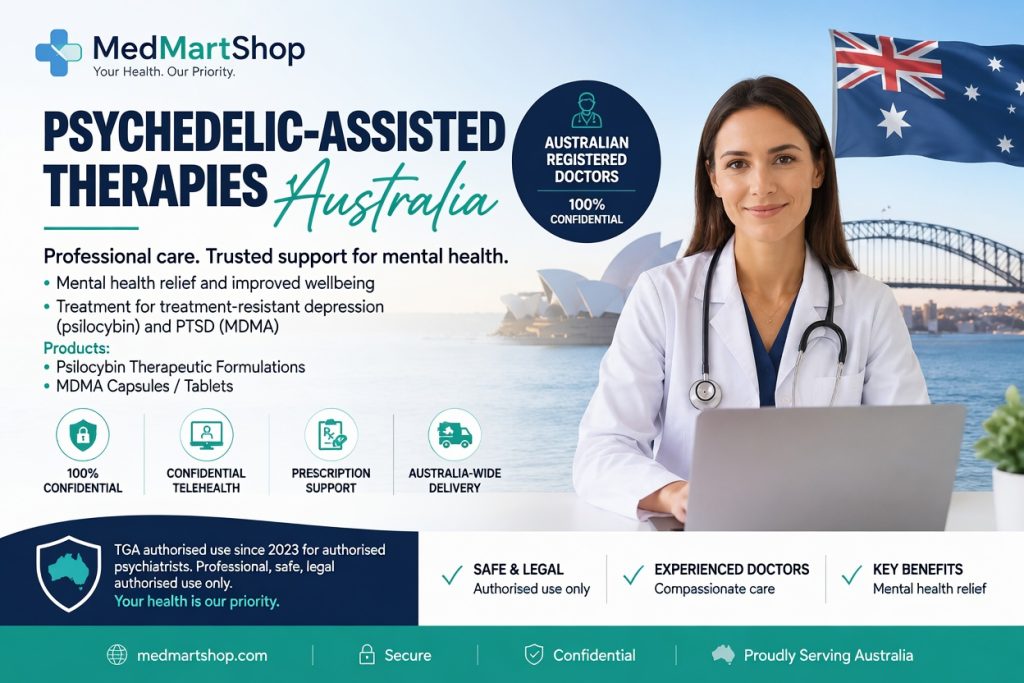
Australia became the first country to allow authorised psychiatrists to prescribe psilocybin for treatment-resistant depression and MDMA for post-traumatic stress disorder from July 2023. This framework operates under the TGA’s Authorised Prescriber Scheme and requires strict compliance with state and territory controlled-drugs rules.
Australian clinical and institutional activity has broadened across psilocybin, ketamine, DMT-harmala, and 5-MeO-DMT work. The Clinical Psychedelic Lab at Monash University has conducted clinical trials using these compounds for depression, anxiety, and post-traumatic stress. Newer local work includes Australian participation in 5-MeO-DMT development.
However, 4-HO-5-MeO-DMT is not part of any clinical research programme. Its obscurity and safety concerns make it an unlikely candidate for therapeutic development.
Harm Reduction and Safety Considerations
Given the complete lack of human research and the neurotoxicity concerns, 4-HO-5-MeO-DMT represents an extremely high-risk compound. No established dosage guidelines exist. No safety data exists. Non reports of human use have been documented in any reliable source.
Researchers have warned that the compound could cause irreversible brain damage by destroying serotonergic neurons. This is not a risk that anyone should take lightly.
For Australians encountering claims about 4-HO-5-MeO-DMT online, extreme caution is warranted. The compound’s obscurity makes it an ideal vehicle for scams or for the sale of mislabelled substances. The Church of Sacred Synthesis controversy demonstrated that even organised groups can make false claims about producing this compound.
Conclusion
4-HO-5-MeO-DMT remains one of the most poorly understood psychedelic compounds in existence. The only scientific report of its synthesis dates back to 1965. No human research has ever been conducted. Researchers have raised serious concerns that the compound could cause irreversible neurotoxicity.
In Australia, 4-HO-5-MeO-DMT would almost certainly fall under Schedule 9 prohibitions due to its structural relationship to psilocin and 5-MeO-DMT. Possession, supply, or manufacture would carry severe legal penalties.
The Church of Sacred Synthesis controversy demonstrated that claims about producing this compound are often unsubstantiated. Independent testing found no evidence of psilomethoxin in the church’s sacrament.
For Australians interested in psychedelic compounds, the responsible path involves focusing on substances with established safety profiles and legitimate research pathways. The clinical trials underway at Monash University and other Australian institutions represent the safest and most legally sound approach. 4-HO-5-MeO-DMT, by contrast, remains a compound that no one should consider exploring given the complete absence of safety data and the significant neurotoxicity concerns.